
Reading the time
Back when I was in primary school, I remember one particular day that perfectly captured a strange but common problem many young students face: telling time on an analogue clock. It was a test day, and, as usual, we had to keep our phones away from our teachers until they were handed back to us at the end of the day, and iPads had to be kept in the bag. No distractions allowed. The teacher told us to keep track of the test timing from start to end. Sounds easy enough, right? Well, not quite.
As the lesson went on, a few kids kept asking the teacher, “What time is recess?” or “How many minutes do we have left?” The teacher pointed to the classroom clock—an old-fashioned analogue clock with hands and all. You could almost see the confusion spreading across the room in some of their faces. Some couldn’t decipher it. Faces were squinting, eyes darting around, trying to understand the position of the hour and minute hands. It was clear: reading analogue time was, for many of us, a mystery.
Looking back, this problem is way more common than we realise. Digital clocks are everywhere now, from phones to microwaves and computers. Kids practically grow up seeing digital numbers, not clock hands. So, when it comes to analogue clocks, it feels like a whole new “language” that students aren’t fluent in. But why does this matter? Isn’t it just easier to teach kids only digital time and call it a day?
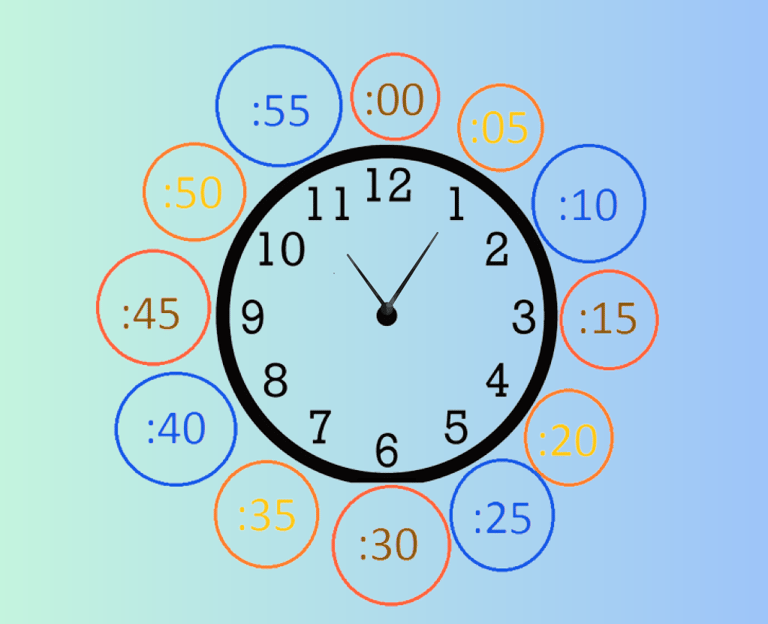
Analogue clocks are still important because they teach us fundamental math skills, such as the concept of multiplication by five. Think about it: each number on the clock represents a 5-minute chunk of the hour. Counting around the clock means multiplying 5 by each number to get minutes past the hour (e.g., 3 times 5 equals 15 minutes). It’s a practical way to visualise multiplication and fractions.
So how can we help students learn to tell analogue time? I think what works best is to break it down into steps. First we should start with the basics. We need to explain to the students that the big hand on the clock moves in 5-minute jumps and the small hand shows us the hour. It is an idea to use a clock that has numbers on it like 5 10, 15 and so on. This way the students can practise counting, by fives while they learn to match the numbers on the clock with the minutes. We are helping the students master analogue time by doing this.
Students need a lot of practice to master analogue time. It is best to start this as early as possible. I remember my parents getting me an analogue watch just so that I would be forced to read the time myself. It actually worked.
You can play games by asking them to read times or set clocks to random times and have the kids write or say what the time is. This is not about memorising times, it is about helping the students understand that the numbers and hands on a clock really mean something. When the students finally understand how to tell time, it feels like they have figured out a code. Telling time is like a code, and when the students get it, it will boost their confidence. Give the students plenty of practice with telling time. They will start to understand that the numbers and hands on a clock are connected.
Thinking back to my days in primary school, I realise how important it is to use traditional skills with modern tools. Yes, digital clocks are easy to use, but analogue clocks offer a special way to improve maths skills. So, next time you see a classroom clock, remember: teaching kids to read it requires patience, practice, and a little bit of multiplication magic!
Keep going! Take your time in understanding your time!